Don't rebrand just to rebrand. Do it for a reason. A new logo should say something the old one couldn't, or make visible what has been true all along. For us, it's the second, and the reason is a story much older than Agiliz itself: the story of how we share meaning.
For thousands of years, sharing meaning was a purely human job. Today, the most demanding consumer of meaning in your organisation might not be a person at all, but an AI agent.
We recently revealed our new logo to the Agiliz family: three squares standing for Trust, Enable and Automate. It isn't a new direction for Agiliz. It's a visual summary of what we've done since day one: giving data its meaning, so people and machines can act on it with confidence.
That made us reflect on a bigger story. Semantics, the art of making sure we mean the same thing when we use the same words, has been evolving for as long as we've had language. The audience has simply changed. We moved from sharing context between humans, to encoding it for dashboards, to handing it to agents that reason and act on their own.
This is that story, and why it matters more now than ever.
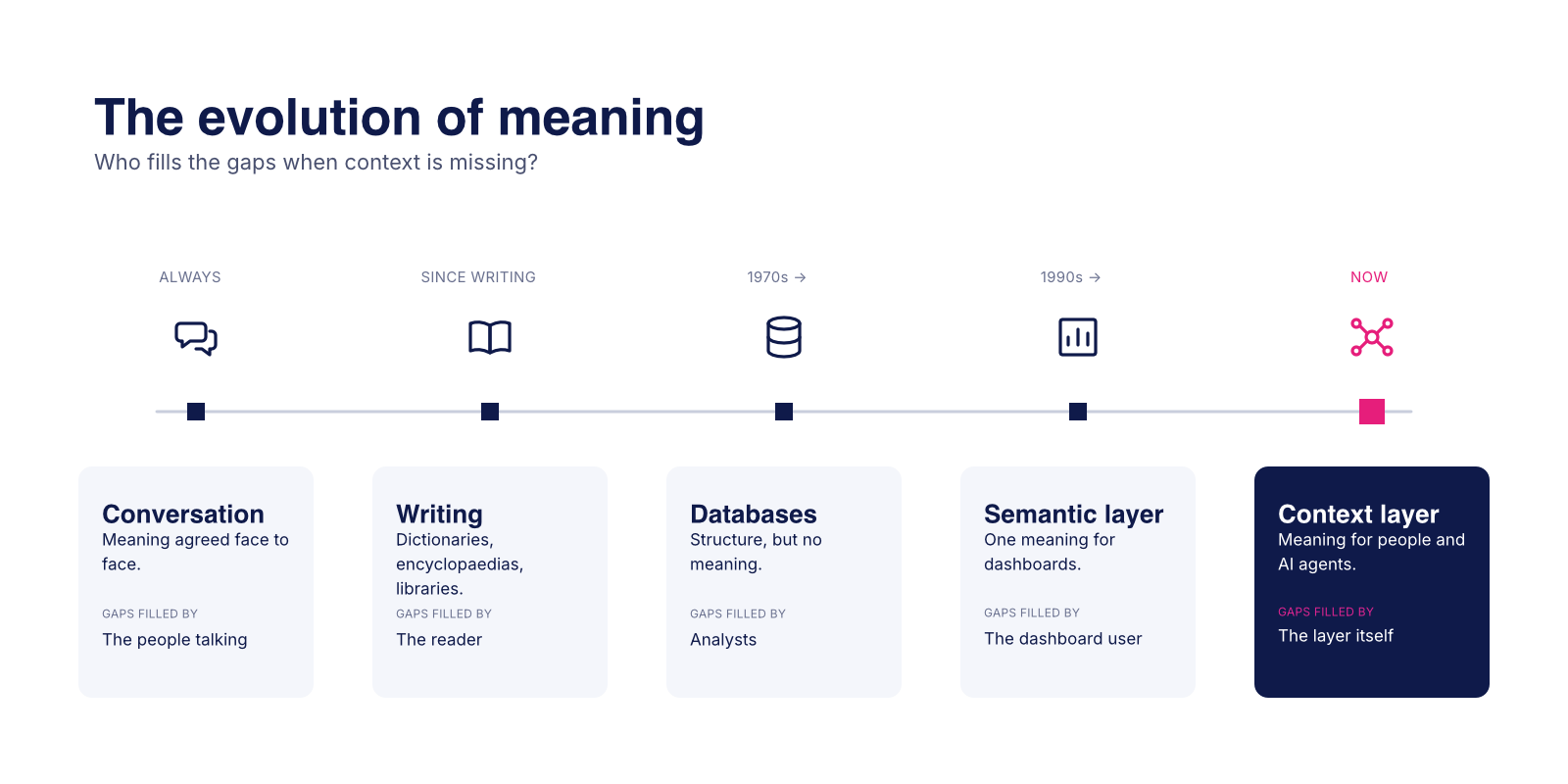
1. When context lived in people
The first semantic layer was conversation. Meaning was negotiated face to face, corrected on the spot and carried in memory. If you didn't understand what "a good harvest" meant, you asked.
Writing changed that. For the first time, meaning could travel without its author. But written words lose the context of the moment, so humanity started building tools to protect it: dictionaries to fix definitions, encyclopaedias to connect ideas, and library classification systems to organise knowledge so anyone could find it.
Inside organisations, the same pattern played out. Shared vocabulary lived in handbooks, procedures and, above all, in experienced colleagues. Ask three departments what "a customer" is and you'd get three answers, but people coped. Humans are remarkably good at filling gaps, asking clarifying questions and reading between the lines.
That human talent for repairing missing context is exactly what machines don't have.
2. When machines learned to store, but not to understand
With computers came a new promise: put all your information in one place and it becomes knowledge. The relational database gave data a rigorous structure of tables, columns and keys. Data warehouses later brought information from many systems together for analysis.
But structure isn't meaning. A column called mar_ex_tax tells a machine its data type, not what it represents, how it's calculated or when it should be used. The meaning still lived in people's heads, in spreadsheets on someone's laptop and in emails explaining "what margin we really have"
The result was a familiar problem: one warehouse, many versions of the truth. Every analyst rebuilt the same logic slightly differently, and every report needed a human to explain it.
3. The semantic layer: one language for business users
The answer was to put meaning between the data and the people using it. In the 1990s, business intelligence tools introduced semantic layers that translated technical tables into business terms like "Revenue", "Region" and "Customer". Business glossaries and data catalogues followed, documenting definitions and ownership.
More recently, semantic layers took the idea further. Define a metric once, govern it centrally, and serve it consistently to every dashboard and BI tool. For the first time, a number in the boardroom could match the number in the sales report.
This was a huge step forward, but it was designed with one audience in mind: humans looking at dashboards. A person reading a chart can still spot when something looks off, question it and decide not to act. The semantic layer only needed to be good enough for people who could fill in the rest.
4. Teaching machines what things mean
In parallel, another movement asked a bolder question: what if machines themselves could understand meaning?
Ontologies described concepts and the relationships between them. Knowledge graphs connected entities into networks of facts: this product belongs to that category, this customer is part of that account, this supplier serves that region. Search engines used them to understand that a query was about a person, a place or a company.
These ideas were powerful but often stayed in specialist corners. Building rich ontologies was hard, and most enterprise systems had no machine consumer that truly needed them. Dashboards didn't reason. People did.
That was about to change.
5. From humans to agents: context becomes the product
Large language models and AI agents have turned semantics from a nice-to-have into a hard requirement. For the first time, the consumer of your data isn't only a person reading a dashboard. It's an agent that interprets a question, decides which data to use and takes action, often in seconds and without anyone checking each step.
An agent is fluent, fast and confident. What it lacks is the knowledge a colleague picks up over years. It doesn't know that "margin" in your company excludes taxes, that "active" means a purchase in the last year, or that two systems use different customer IDs for the same client. When that context is missing, it doesn't ask. It guesses. That's where hallucinations, conflicting answers and broken automations come from.
So the job of semantics has shifted:
• For humans, semantics explained the data, and people filled the remaining gaps.
• For agents, semantics must be the context: explicit, governed and machine-readable, because nobody is filling the gaps.
This is also why new standards for connecting agents to tools and data are emerging so quickly. Access alone isn't enough. An agent with access to every table but no understanding of what they mean simply produces wrong answers faster.
From semantic layer to context layer
The semantic layer we've described in step 3 is still the foundation, but agents need more than definitions. A semantic layer tells an agent what a metric is. An agent also needs to know why it matters, how the business uses it and what it's allowed to do with it.
That's why the semantic layer is growing into a broader context layer. It keeps everything a semantic layer offers: governed metrics, dimensions and one shared business vocabulary. Then it enriches that foundation with business context, bringing together the ideas of step 3 and step 4:
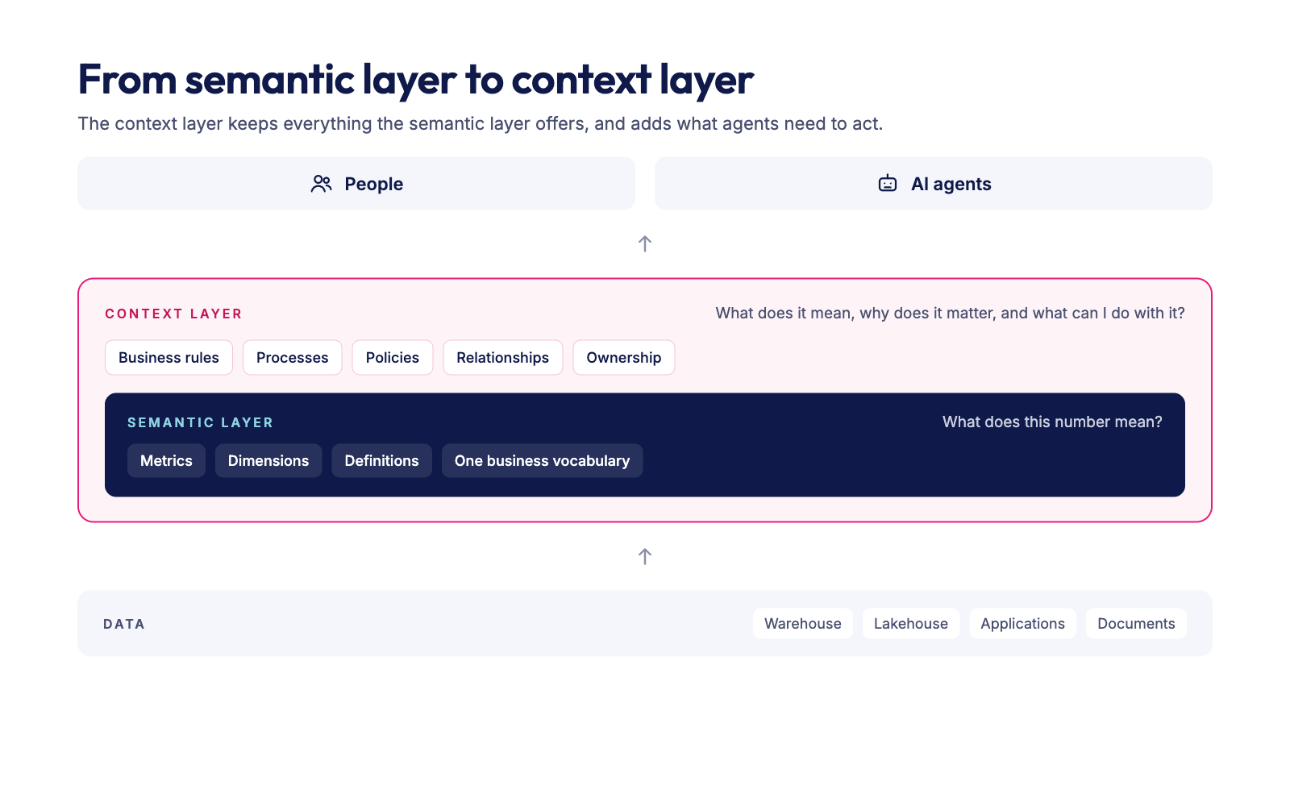
The context layer has become the shared language between your people and your agents. When both work from the same definitions, the answer in the boardroom matches the answer from the chatbot, and trust can finally scale beyond the team that built the data.
6. Trust, Enable, Automate: the three squares in our logo
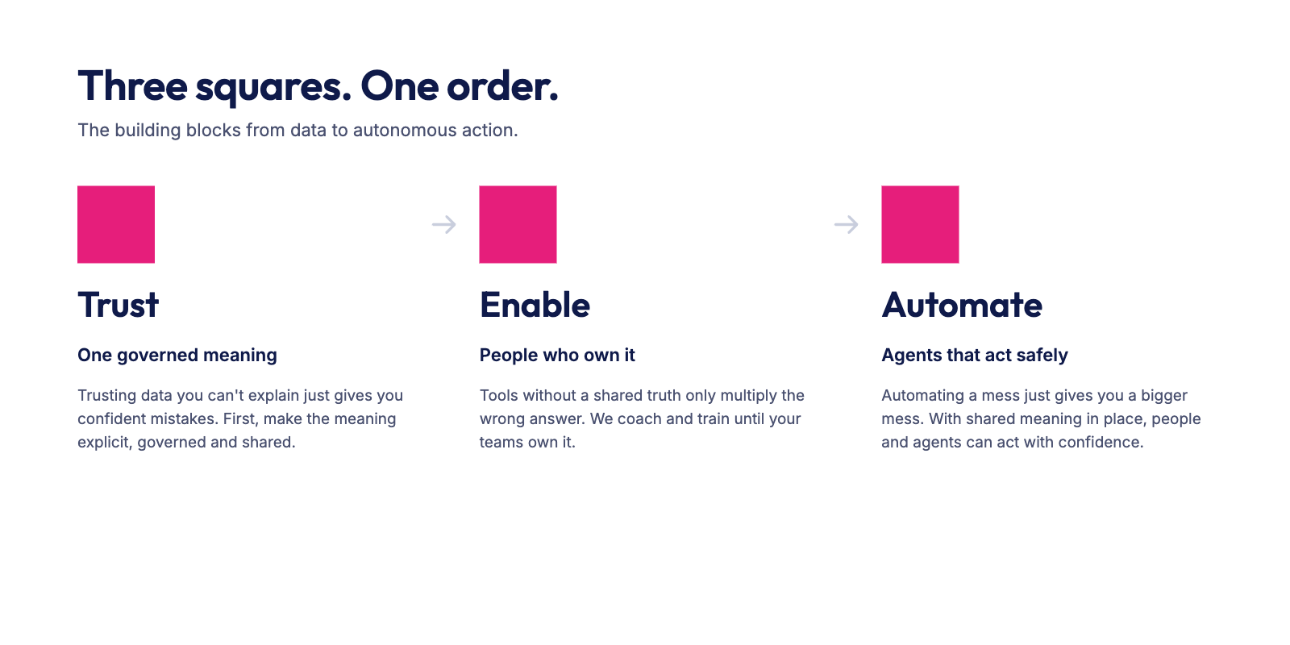
Looking back at this evolution, one lesson stands out: every step forward in how we use information depended on getting the meaning right first. That's the thinking behind the three squares in our new logo. They're the building blocks of the journey from data to autonomous action, in this order.
Trust. Trusting data you can't explain just gives you confident mistakes, your data isn't AI-ready until it's unified and trustworthy. A rich context layer maps the business context, relationships and true meaning of data across systems, so both people and agents can act with confidence.
Enable. Empowering people without a shared truth just coaches them to make more versions of the wrong answer. We don't stop by building, we coach, train and support every user to master them.
Automate. Automating a mess just gives you a bigger mess. Once meaning is shared and governed, we automate semantic modeling, documentation, quality, lineage and governance.
None of this is new for Agiliz. Semantic Intelligence has been our differentiator from the start, across Strategy, Google Cloud, Databricks and mixed technology stacks. What's new is that our brand now says it out loud.
The next chapter of meaning: the evolution of trust
Look closely and the story of semantics is really the story of trust. First we trusted the person in front of us. Then we trusted the written word, the report and the dashboard. Now we're asked to trust AI agents that act on our behalf.
Each step demanded a stronger foundation than the one before. A conversation could be corrected on the spot. A dashboard could be questioned by the person reading it. An agent that executes a decision in seconds leaves no such safety net.
That changes what "one version of the truth" really means. One truth is no longer just a BI nicety that keeps dashboards aligned. It's a prerequisite for letting AI act on the business's behalf. When machines act for us, the context we give them is the difference between intelligent automation and automated chaos.
One Truth. Our Story.